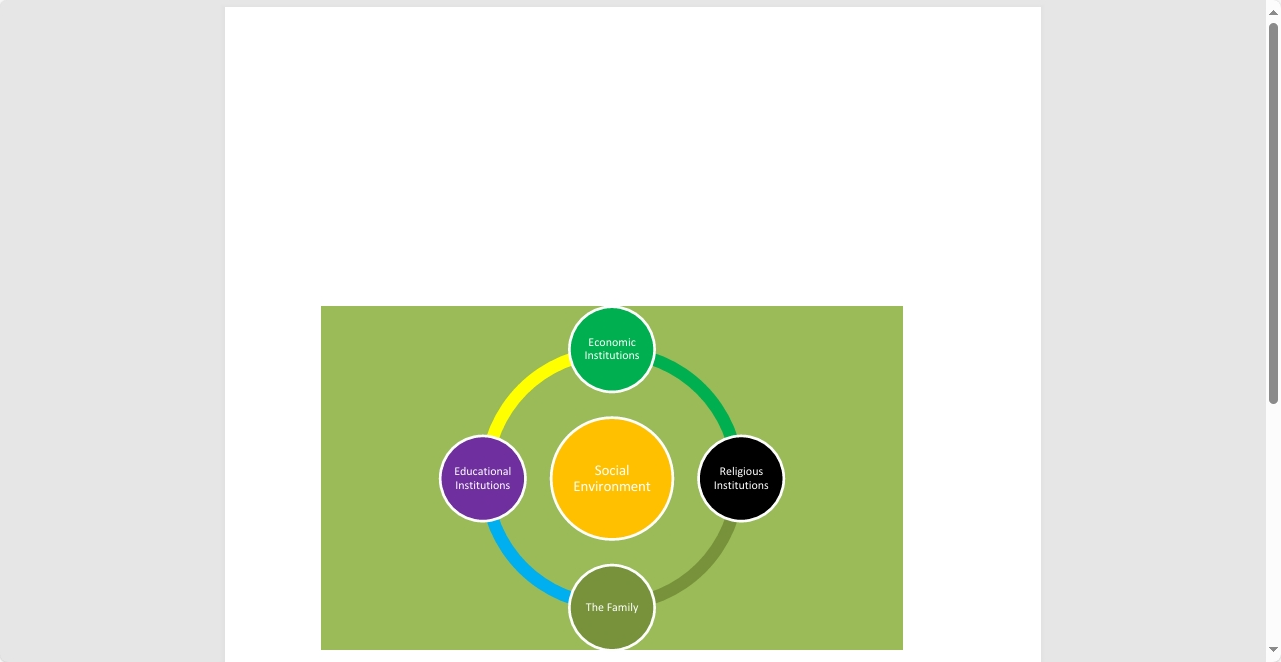
'Understanding Social Institutions', is a dissection of the structure of the society to reveal the building blocks of the society, known as 'social institutions'.
Social institutions can be defined as the accepted patterns, procedures, and modalities for doing things characteristic of a given society.
Social institutions can also be defined as established practices and usages controlling the relationship between individuals upon which the society is organized.
Social institutions can be seen as a sort of super customs, a set of mores, folkways and patterns of behaviour that deals with major social interests such as family, politics, economic activities, et cetera.
1. Definition of Social Institutions
1.1. Introduction……………...1
1.2. Meaning of Social Institutions ....................1 1.3. Components/Elements of
Social
Institutions……………………............. 5
1.4. Using Components to
Define
Institutions……………………............... 7
1.5. Institutions and Social Structure……,,,,,,,,,,,,,,, 10
1.6.Classification of Institutions…………................. 12
1.7Characteristics of Institutions……...................... 15 1.8.Functions of Social Institutions……................... 18
2. Family Institutions 21 2.1. The Family.................................................... 21 2.2. Family Formation……………….........................25
2.3.Institutions of the Family………........................ 31
2.3.1. Family Institutions……... 32
2.3.2. Marriage Institutions…... 42
2.4. Theoretical Perspectives of the
Family…………………………….....................47
2.4.1. Functionalism and
Family Analysis……...... 48
2.4.2. Conflict Theory and
Family Analysis….......... 50
2.4.3. Symbolic Interactionism and the Family………….54
2.4.4. Exchange Theory
and the Family……........... 56
3 Educational Institutions
3.1.Introduction……………..................................... 59 3.2 What is Education?..........................................60
3.3 Types of Education…………....................……62
3.3.1. Formal Education .... 63 3.3.2. Informal Education ... 65
3.4 Functions of Education…………..68
3.5 Theoretical Perspectives of
Education…………………………....................73
3.5.1
Functionalism and
the Analysis of
Education…………….73
3.5.2 The
Conflict/Critical
Theory in the Analysis
of Education…………74
3.5.3 Symbolic Interaction-
Ism and the Analysis
of Education………...77
3.6 Agents of Socialization…………......................80
3.6.1 The Family……….....81
3.6.2 Peer Group………....82
3.6.3. School……........…..86
3.6.4. Mass Media…........88
4. Economic Institutions 92
4.1. Introduction………………………………......... 92
4.2. The Importance of Economic
Institutions …………………………………....... 94
4.3. Economic Institutions in the
Production
Sector: Factors of
Production ………….......... 95
4.3.1. Capital/Wealth….. 96
4.3.2. Land………….105 4.3.3.Labour……06
4.3.4. The Entrepreneur ..108
5 Political Institutions 110
5.1. What is Politics?
…………………………...… 110
5.2. The Origin of Politics…………………............ 110
5.3. What is
Power?.............................................. 112
5.4. Types of Power …………………..................... 114
5.4.1. Illegitimate Power……..114
5.4.2. Legitimate
Power……..116
5.5.Political Institutions :………………….............. 119
5.5.1. The State ……............. 120
5.5.2. Government……………..125
5.5.3. Constitution……………..146
6 Religious Institutions 156 6.1 What is Religion?...............................156 6.2 Elements of Religion…………………...156. 6.2.1 Sacred Entity……………….158
6.2.2 A Set of Beliefs and
Symbols……………………..159
6.2.3 Rituals………………………160
6.2.4 Community of Believers-
Religious Organizations…..160
6.2.4.1
Ecclesia………..162
6.2.4.2 Denomination
(the
Church)…….163
6.2.4.3 Sect ……………..166
6.2.4.4 Cult…………168. 6.3. Classification of Religion ..........170
6.3.1 Theism……………………...172
6.3.2 Ethical Religion ………….175.
6.3.3 Animism……………………176
6.3.4 Animatism………………….177
6.4
Functions of Religion………………..........…...178
6.5
Theories Used in Putting
Religion into
Perspective……………..........182
6.5.1
Functionalists Approach to
the Analysis of Religion….183 6.5.2 Conflict Theory and the
Analysis of Religion………184
6.5.3 Symbolic Interactionism and
the
Analysis of Religion…..186
References…………………………………..………..188
1ndex…………………………………………………..198

The author hails from Anambra State of Nigeria. She holds a B.Sc. Certificate in Sociology & Anthropology, which was awarded to her by the Department of Sociology & Anthropology, University of Benin, Benin City, Nigeria, in 1989. She also holds an M.Sc. and a PhD Certificates in Population and Environmental Studies, awarded to her by the Department of Sociology & Anthropology, University of Nigeria, Nsukka, in 1999 and 2021 respectively. She has published three journal articles. Understanding Social Institutions is her maiden textbook publication. Two of her books; one in the aging process and one in human behaviour are being edited for publication, while another two in population studies and demography are still in the infant stage of development.